
Whether you are a mountain leader, a lowland leader or just a regular adventurer a first aid kit is a wise addition. As a leader it’s essential as well as a 16hr outdoor first aid qualification.
Even as an everyday adventurer you never know the sorts of scrapes you and your friends may get into especially in the mountains. For this reason I thought I’d create a useful post on how to build yourself a first aid kit for mountain leading or for use as a well prepared adventurer.
For Trainee Mountain Leaders: The Law
If you are running outdoor sports /adventure activities as or for a business, due to the law you’ll need to know how to use a first aid kit and at least know what is required by the HSE. It is worth noting that what they list is this is however very basic and nowhere near the level of kit a mountain leader with a group should have with them. Despite this It’s worth noting there’s also no limits on the extras you can supplement your basic first aid kit with, depending on your preference or situation. According the the HSE you should have the items pictured below and these are fine but realistically they barely cover all the different injuries you could get in the mountain environment.

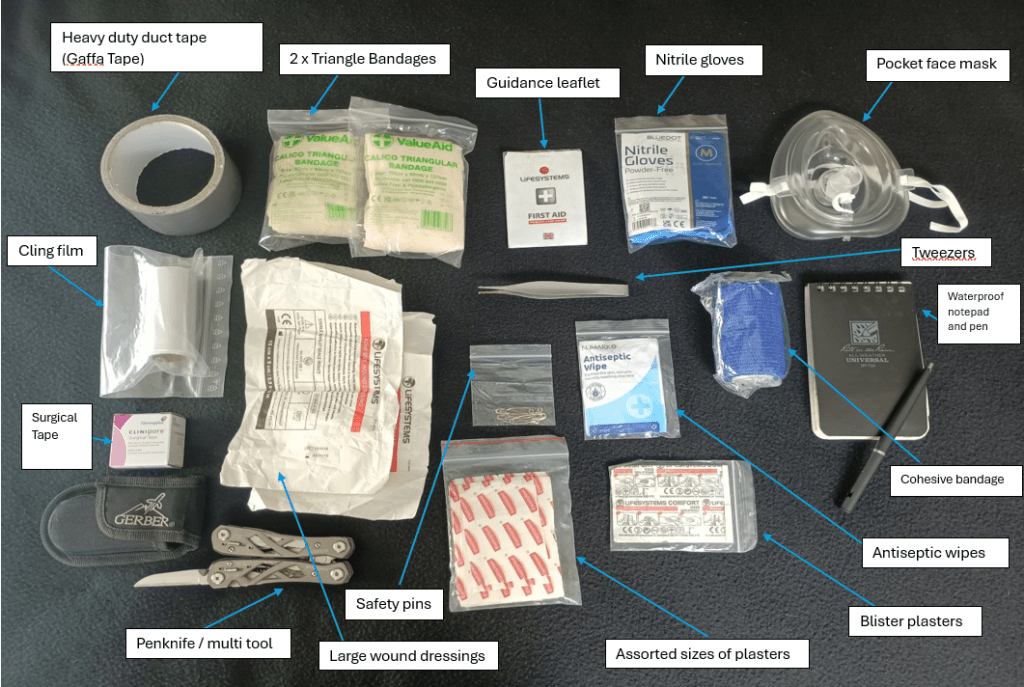
Pictured below are the items recommended as a Mountain Leader at minimum, which are more comprehensive than the HSE version. This depiction is based on the suggested first aid carry from the Hillwalking : The Official Handbook of the Mountain Training Walking Schemes by Steve Long. This is a great guide and you can buy it from Amazon via this link: Hillwalking
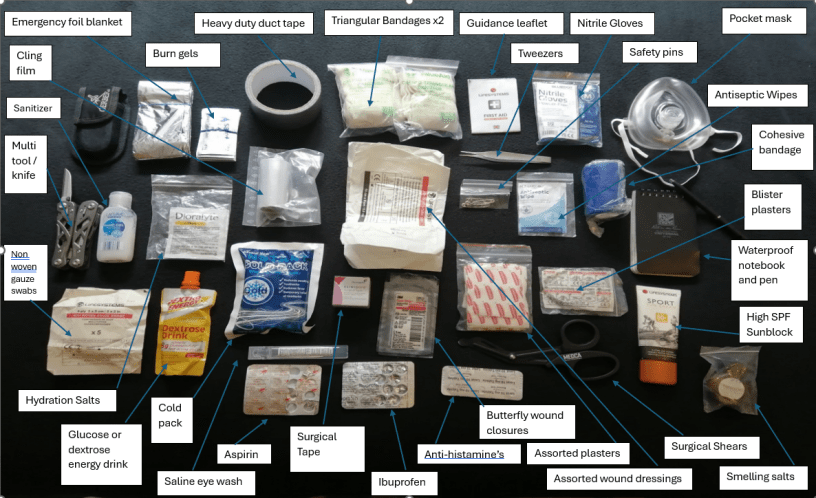
Pictured below I take in my first aid kit and you might be asking what all this stuff is for, well here’s and explanation of why I have this stuff in my kit. Some of it has been added over time due to situations arising and some are additions following my 16hr outdoor first aid course. This more than covers most situations, and I carry this with me on the majority of my adventures.

It seems like a lot, and it is however leading a group of people can result in lots of different injuries and people often have different medical issues. It’s unwise to think everyone is going to disclose their medical issues, they may be embarrassed, they may think that it isn’t worth telling you or they may underestimate just how much danger their condition could put them in when in the mountain environment. So here’s a brief explanation of what all of these items are for.
Emergency Foil Blanket: Excellent to use on someone who has got too cold, and prevent hypothermia. This can happen is someone is dressed incorrectly for cold weather, gets wet or stays out in the cold too long and their body temperature drops below 35 degrees Celsius. The foil blanket reflects body heat back in in fact up to 90% of it. One of these is invaluable and they vary from the basic ones to the even more effective emergency survival bivvy bags. I can highly recommend the Lifesystems Heatshield Thermal Bag. This product helped save my life once, they pack down very small and I’d class it as an essential bit of kit Link Here
Burn Gels: Using equipment like camping stoves outside can occasionally cause injury, carrying a burns kit is always wise, it happens infrequently but it’s best to be prepared. Burns easily get infected especially in the outdoors so it’s wise to treat them correctly. For minor burns It’s recommended you run a burn under cool water for 20 minutes, something which may be impossible in outdoor situations, burn gel is usually mainly water, and it helps cool and protect the burn. Paired up with cling film this is pretty effective.
Cling film: is utilized for covering burns to prevent contamination and infection. Being plastic, it does not leave anything like lint or fibres in the wound as fabric dressings might. It is advised to wrap it loosely, and when used with burn gel, it will adhere slightly to the gel.
Heavy Duty Duct Tape: Good for improvising splint bindings, and can be used in lots of creative ways beyond medically such as kit repair.
Triangular Bandages: Usually used foremostly as slings for elevating an arm but can also be used as a normal bandage or dressing if sterile. See video below from SJA.
Guidance leaflet: Most people don’t remember everything from their first aid course, if you are lucky you probably won’t have to use it that often however if you don’t get opportunities to practice, memory fades. And even if your memory is amazing, putting things into practice when shit hits the fan is not that easy. It’s always good to have something to remind you when everything has turned into a stress. If you start with a ready made first aid kit keep the guidance leaflet, if not buy one. It could be the difference between your patient going home or not.
Tweezers: For ticks and removing splinters / objects from wounds, you can get tweezers specifically for ticks also, standard tweezers are a pretty good all rounder however.
Aspirin: Can be used for general minor pain relief and headaches but also used for those suffering heart attacks. The NHS advise that a heart attach patient chews a 300mg tablet of aspirin while waiting for the emergency services to arrive.
Ibuprofen: It’s good to have a range of pain killers, Ibuprofen is useful for mild to moderate pain and reduces inflammation. Needs to be taken with food as can cause stomach upset, which isn’t great on a mountain.
Medical Shears: Many uses but a decent pair can cut through clothing, tough materials, belts. A lot of outdoor clothing is designed to be extremely tough, it is not like regular everyday clothing and a set of shears could be indispensable. Can also be used to cut tape, bandages and other items.
Butterfly strips / stitches: Useful for closing wounds that would require stitches later, I know people who are more than capable and qualified to stitch people up in the field but I’m not plus these are much quicker as a temporary fix until you can get them somewhere it can be done properly.
Hydration salts: Dehydration. You would think people would be sensible enough to take water with them and drink enough of it but if you know people you also know this isn’t always the case. It can also happen due to being in the sun too long and from Diarrhohia which can be caused by illness (these are really handy to have if you like travelling to exotic places also!) These taste pretty grim by the way but they do work, personally I use the Dioralyte sachets.
Glucose: Diabetics / exhaustion, we all forget to take our medication at some point even diabetics.For this reason carrying glucose tablets or shots is wise. Diabetics can get hypoglycaemia (low blood sugar) symptoms of this being dizziness, blurred vision, tired or weak feeling and confusion. None of which is good in the dangerous environment of the mountains. Occasionally you will have a party member who wears themselves out or doesn’t eat enough that day too, and glucose is always useful for this as an energy boost.
Eye wash: Getting grit or dirt in the eye isn’t often thought of but it can happen in a outdoor setting, debris falling if you are a climber or high winds are two ways this can happen. Saline eye wash tubes are cheap and a worthwhile carry.
Blister dressings: One of the most common injuries with new walkers especially with people who have not got boots fitted, is blisters. These can really hamper someone walking and can be very painful. I can highly recommend the compeed extreme blister plasters, these are the best I’ve used. COMPEED
Pad and paper: Patient information, in case of mountain rescue in a stressful situation you can easily forget something an injured person has said, how and when an incident occurred and other information. Having it written down clearly for rescue or MRT makes life a lot easier. If you want to be very precise, it’s worth either making your own patient report forms or having them printed.
Cohesive bandage Really useful flexible bandage that sticks to itself, great for making knee / elbow supports, also for compression for sports injuries such and sprained ankles and firmly holding dressings in place. Tradition crepe bandages are also a wise carry as they are more breathable.
Insect bite cream: Most mountain areas in the UK are the home of a number of biting insects such as tics, horseflies and midges. At certain times of year midges can make your time in the outdoors extremely uncomfortable. Carrying some insect repellent as a preventative measure as well as bite cream is wise. I have to admit this is something I tend to forget and get a rude reminder later on.
Nitrile Gloves: Usually listed as latex gloves, which are close fitting and better for high risk tasks. Some people actually have an allergy to latex, so it’s better go go with nitrile being also close fitting and unlikely to trigger a reaction for you or the patient.
Non woven gauze swabs (Sterile): These have a few uses one being mopping up blood. They come in a lot of sizes and can be used as a dressing that is absorbent for cleaning and drying around wounds. Non woven swabs are useful as they don’t leave any lint in the wound.
Sunblock: The higher altitude you are at the more chance of you getting sunburnt in fact every 1000ft you gain the exposure to UV raises by 5%. This might not seem much of a concern however, if we take the UK’s tallest mountain Ben Nevis as an example at 4,413ft at the peak your UV exposure is roughly 22% higher than it is at sea level. Lifesystems do great heavy duty factor 50+ mountain formula sunscreen which lasts 8 hours. LIFESYSTEMS SUNCREAM
Smelling salts: Usually used to revive people who have fainted, heat stroke, lack of food hydration can all cause this. How do they work? The fumes of ammonia nitrate irritate the linings of the airways which causes a breathing reflex the body does this to clear the airways of the chemical which (if you give it a sniff while conscious is pretty brutal) this breathing reflex can help revive a patient, though it is pretty unpleasant.
Instant Cold Pack: These things are really useful for sprains and bruising and because they work through a chemical reaction don’t require a refrigerator.
Pocket mask: Useful for CPR so you don’t have to give direct mouth to mouth, not only is it uncomfortable for both of you…having your mouth around a strangers isn’t really how we wan’t the day to end. Also forms a better seal. Here’s a useful link for CPR https://www.sja.org.uk/get-advice/first-aid-advice/unresponsive-casualty/how-to-do-cpr-on-an-adult/
What to put it all in
Plenty of outdoor brands do their own bags for first aid kits, as it’s for outdoors you can use just a normal dry bag or a obvious first aid labelled one. For mine I use the lifesystems first aid marked dry bag, this is pretty heavy duty and pretty obvious being bright red. It fits all this gear bang on and as the name suggests it is waterproof so it keeps all my kit dry. Lifesytems First Aid Dry Bag
Anyway I hope this blog has been some use to people, and feel free to drop a comment if you feel I’ve missed anything or you found this helpful!
 Requiem For The Extreme